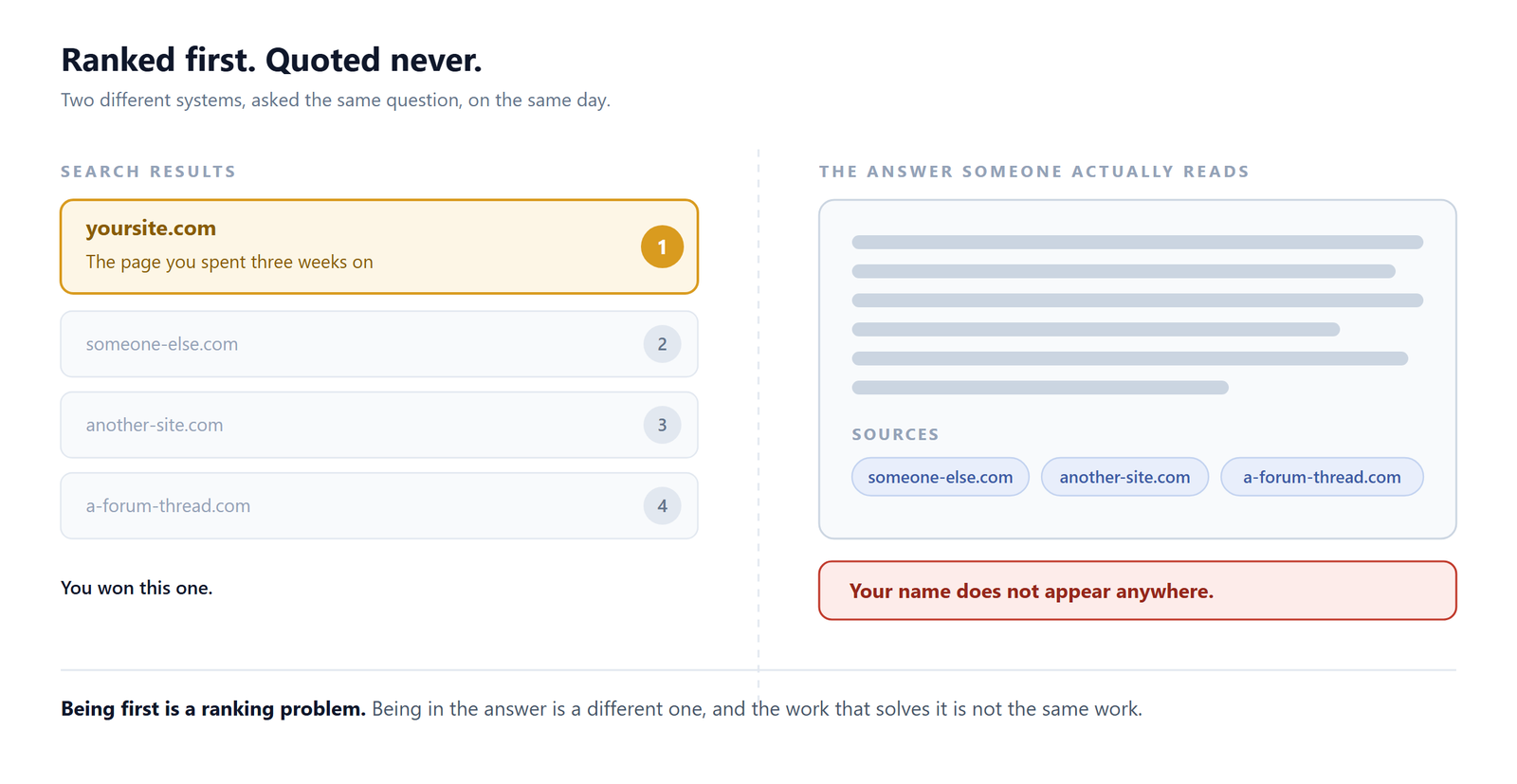
You are first on Google for a question. You ask the same question in ChatGPT, and it answers using three sites you have never heard of. Yours is not among them.
Nothing is broken. You are being measured by two different systems that want two different things, and only one of them is the one you optimised for.
Ranking picks pages. Answering picks passages.
A search engine's job ends when it hands you a list. It decides which pages are most likely to help, puts them in order, and stops. Whether you actually find your answer on the page is your problem.
An answer engine cannot stop there. It has to produce the answer itself, which means it needs a passage it can lift and stand behind. So it is not looking for your best page. It is looking for the two sentences on it that answer the question completely, without needing the rest of the page to make sense.
If those two sentences do not exist on your page, being first buys you nothing.
What can actually be lifted
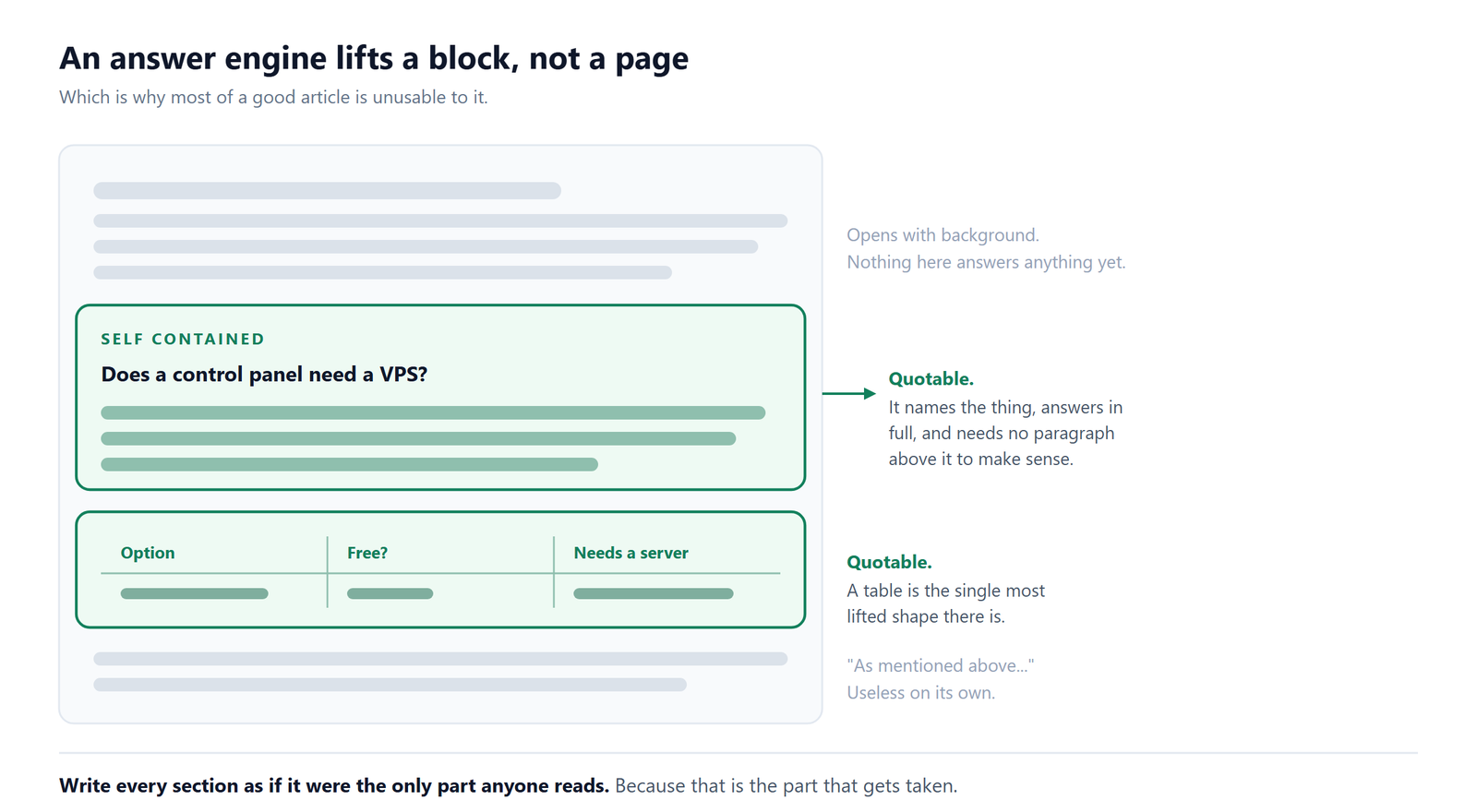
Once you look at a page that way, most of it turns out to be unusable.
Openings that set up context answer nothing. Paragraphs that begin "as mentioned above" cannot survive being taken out of the page. A section that only makes sense after the two before it is, to a machine deciding what to quote, dead weight.
What survives is the block that stands on its own: it names the thing, it answers in full, and it does not lean on anything around it.
The five things I changed on my own site
I run numroq.com, a calculator platform with a couple of hundred tools. These are the five changes I made. All of them are visible on the live site, so you can check them rather than take my word for it.
1. The answer moved into the first forty words. Every article now opens by answering the question it is named after, before any background. Not because it reads better, though it does, but because that is the part an engine reaches first and the part a featured snippet takes.
2. Every section was rewritten to stand alone. The rule I gave myself: if this heading and the paragraph under it were the only thing quoted, would it still be correct and complete? "As mentioned above" is now banned in my own writing, which sounds petty and turned out to be the single most useful rule of the five.
3. Lists of things with attributes became tables. A table is the most lifted shape there is, because it is already structured, and turning a paragraph into one costs nothing. This is the cheapest change on the list and I left it far too late.
4. Real questions, with FAQPage markup. Not invented questions that set up a sales line. Actual things people ask, answered completely in one paragraph each, marked up so a machine can tell a question from a heading.
5. A set of pages that exist to be cited. numroq.com has a reference section of plain factual tables: an Abjad value table, a Chaldean chart, a comparison of numerology systems. No selling, no story, just the reference itself. There is also an llms.txt at the root, which is a short plain description of what the site is and what is on it.
That last one is the least certain item on this list, and I would rather say so
than oversell it. llms.txt is a young convention, not a standard anybody is
obliged to honour. It costs twenty minutes and it might do nothing. The reference
tables, on the other hand, are worth building even if no AI ever reads them,
because people link to a good reference table.
What made no difference
This is the part most articles on this subject leave out.
Adding schema to a page with nothing worth quoting. Structured data describes what is on the page. It cannot invent an answer that is not there. I marked up several thin pages early on and nothing changed, because the problem was never the markup.
Writing longer. Padding a 700 word article to 1,800 makes it harder to lift a passage from, not easier. Depth helps. Volume does not.
Keyword density. It has not helped ranking for years and it does not help here either. An answer engine is reading for meaning, and repeating a phrase nine times looks like exactly what it is.
How to tell whether it is working
Honestly: imperfectly.
There is no rank tracker for this. What you can do is ask the engines your own questions, regularly, and write down what they say. Ask the five questions your customers actually ask. Note which sites get named. Do it again in a month.
Watch for mentions, not just links. An answer engine will often name a brand without linking to it, and that mention is doing the work a backlink used to do. If your name starts appearing in answers, that is the signal, even with no click attached.
And be suspicious of anyone selling you a precise measurement of this today. The tooling is not there yet. I can tell you what I changed and I can show you the pages. I cannot draw you a graph proving which change caused what, and neither can they.
The short version
- Ranking picks pages. Answering picks passages. Optimising for one does not optimise for the other.
- Answer the question in the first forty words.
- Write every section so it survives being quoted alone.
- Turn lists of things with attributes into tables. It is free.
- Answer real questions, and mark them up.
- Build a few pages whose only job is to be a citable reference.
- Do not pad. Do not repeat keywords. Do not trust a precise number.
None of this is a trick, which is the point. The work that gets you quoted is the work of being genuinely, specifically useful in a shape a machine can pick up.
Frequently asked questions
What is GEO?
GEO is generative engine optimization: the work of getting your content mentioned and cited by AI tools like ChatGPT, Perplexity and Google's AI answers. It overlaps heavily with SEO but optimises for a different unit. SEO competes to have your page ranked; GEO competes to have a passage from it quoted.
Does GEO replace SEO?
No. They share most of the same foundations: a technically sound site, genuinely useful content, clear structure. GEO adds a requirement on top, which is that individual sections must be complete on their own. A site that is good at SEO and badly structured for quoting will rank and go unmentioned.
Is llms.txt worth adding?
It costs about twenty minutes, so probably yes, but keep your expectations honest. It is a young convention rather than a standard, and no AI company is obliged to read it. I added one to my own site. I cannot show you that it changed anything.
How long does this take to show results?
I do not have a reliable number for you, and I would distrust anyone who gives you one confidently. Ranking changes are slow and measurable. Citation changes are slow and, right now, hard to measure at all. Judge it in months, by asking the engines directly, not in weeks by watching a dashboard.
Can I just add schema and be done?
No. Structured data describes what is on your page; it cannot create an answer that is not there. If the page has no self-contained passage that answers a real question, marking it up changes nothing.